Custom T-Shirt Pricing Calculator
Enter what the blank, the print and the extras cost you, plus your fees and the margin you want. The calculator gives the price to put on the shirt, your profit per shirt and your profit on the whole order.
What you pay for the plain tee, before printing.
DTG, screen print, DTF, heat press or embroidery. Use your printer's quote.
Screens, digitizing or artwork prep. Spread across the quantity. Use 0 if there is none.
Use 0 if the customer pays shipping.
The percentage taken from each sale. Check your own platform or card processor.
Many card processors add a flat amount to each payment.
Margin is profit divided by the selling price.
Leave 0 to get a suggested price. Enter a price to see what you would earn at it.
Price and profit per shirt
Suggested price per shirt
$20.27
| Blank shirt | -$4.50 |
| Print or decoration | -$5.00 |
| Setup cost spread over 50 shirts | -$1.00 |
| Labels, packaging and extras | -$0.75 |
| Total cost per shirt | $11.25 |
| Suggested price for your target margin | $20.27 |
| Payment or marketplace fees per shirt | -$0.91 |
| Profit per shirt | $8.11 |
| Profit margin (of price) | 40.0% |
| Markup over your cost | 80.2% |
| Profit if all 50 shirts sell | $405.60 |
| Break-even price (profit of zero) | $11.91 |
Based only on the numbers you enter. Ask your printer for a written quote, and remember sales tax, returns and discounts are not included.
How to price a custom t-shirt
Start from what one finished shirt costs you, not from what other shops charge. Add the blank, the print, any setup cost spread across the order, and the small things people forget: the neck label, the polybag, the mailer. That is your cost per shirt.
Then decide the margin you want and add the fees taken from each sale. The price is the cost plus the fixed fee, divided by what is left after the fee percentage and your margin. The calculator does this sum and rounds up to the cent, so you never land a cent short of your target.
Margin and markup are not the same
Margin is profit as a share of the selling price. Markup is profit as a share of your cost. A 100% markup means the price is double the cost, which is a 50% margin. Mixing the two up is how shirt shops end up with less profit than they planned.
| Target margin | Price as a multiple of cost | Equivalent markup |
|---|---|---|
| 30% | 1.43 x cost | 43% |
| 40% | 1.67 x cost | 67% |
| 50% | 2.00 x cost | 100% |
| 60% | 2.50 x cost | 150% |
Why quantity changes the price
Setup costs are paid once per order, so the more shirts in the order, the less each one carries. Screen printing in particular has a setup per colour, so small runs cost more per shirt than big ones. With the default numbers above (a $50 setup, $4.50 blank, $5 print, $0.75 extras, a 3% + $0.30 fee and a 40% margin) the price moves like this:
| Order size | Cost per shirt | Price for 40% margin |
|---|---|---|
| 12 shirts | $14.42 | $25.82 |
| 50 shirts | $11.25 | $20.27 |
| 200 shirts | $10.50 | $18.95 |
Costs people forget when pricing shirts
- Test prints and samples before the first real order.
- Spoiled shirts: some blanks and prints will be misprints.
- Shipping supplies and the time to pack each order.
- Returns and exchanges, which cost you the shirt and the postage.
- Sales tax or VAT rules where you sell, which are separate from your margin.
- Marketplace and card fees, which come out of every sale.
Retail and wholesale prices
If you want boutiques to stock your shirts, they need to double your wholesale price to reach their own retail price, a common rule of thumb in apparel. Work out the wholesale price first, with a margin you can live on, then check that the doubled price is one a customer will pay. Our line sheet generator turns the result into a sheet to send to buyers.
Ways to lower your cost per shirt
- Order in bigger batches to spread screen and setup costs, but only once the design has sold.
- Choose a print method that matches the order size: DTG and DTF suit small runs, screen print suits repeat runs.
- Compare blanks. A slightly cheaper shirt may feel worse; test the wash and feel before you switch.
- Reduce print size or colours where it does not hurt the design.
- Sell bundles or multi-buy offers so shipping and fees are spread over more shirts.
What goes into the price of a custom t-shirt
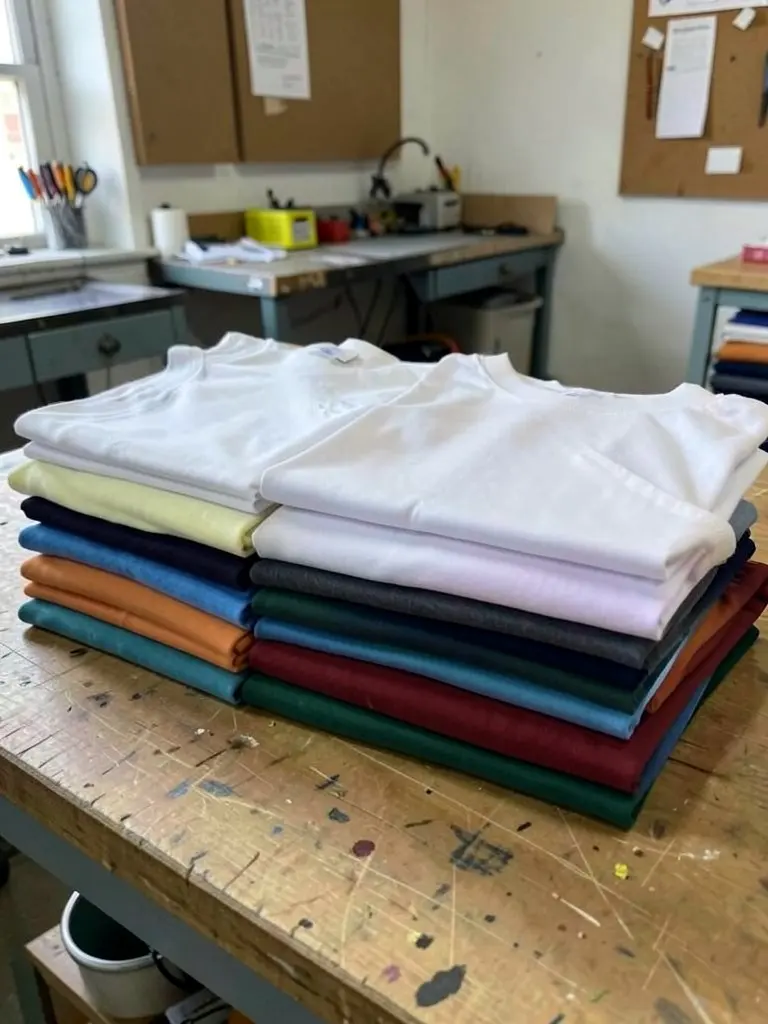
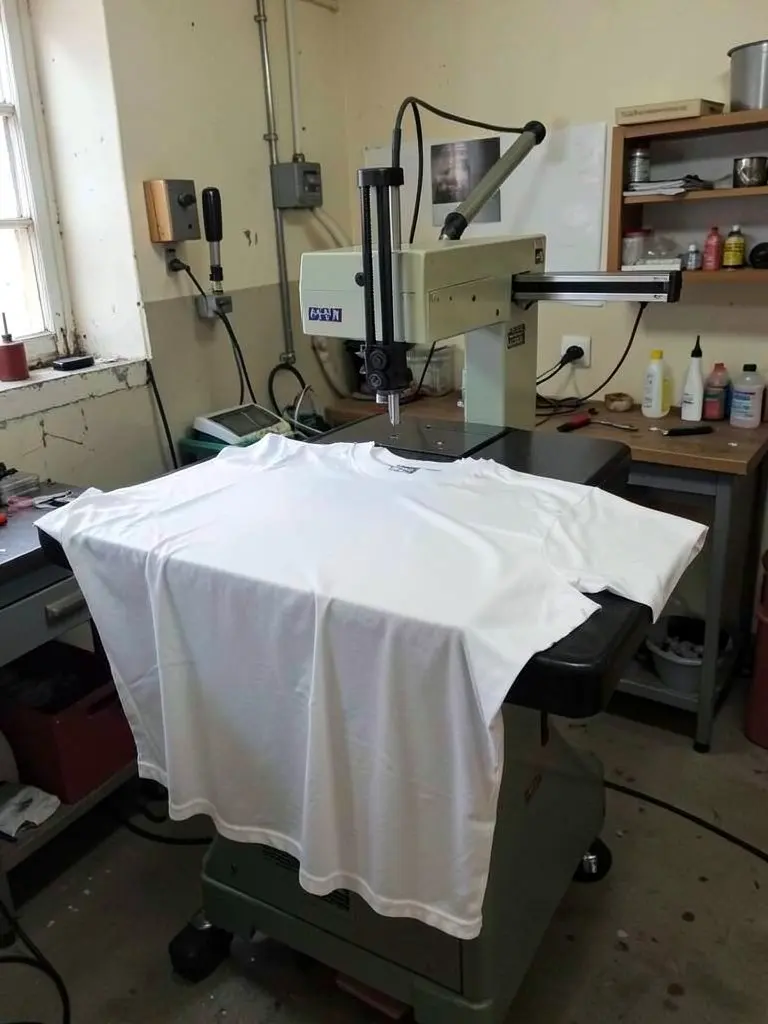
The price covers the blank tee, the print, your time and your shipping, plus the margin you want to keep. Blanks in several colours, the heat press time and the packed weight each change your cost per shirt.
These example photos are AI-generated with our own model. They show a stack of blank tees, a heat press and a tee on a scale.

FAQ
How do I price a custom t-shirt?
Add the blank, the print, any setup cost per shirt and extras to get your cost. Then divide cost plus the fixed fee by one minus the fee percentage and your target margin. This calculator does that for you.
What is a good profit margin for custom t-shirts?
That depends on your costs and how you sell, so there is no single correct number. Many small shops aim for a margin that leaves room for fees, returns and discounts; try 40% to start and test the price.
What is the difference between markup and margin?
Margin is profit divided by the selling price. Markup is profit divided by your cost. A 100% markup equals a 50% margin.
Does this include shipping and sales tax?
Only shipping you pay per shirt, if you enter it. Sales tax or VAT is not included because it depends on where you sell.
Why is the price per shirt higher for small orders?
Setup costs, such as screens or digitizing, are paid once per order. A small order spreads them across fewer shirts.
Where do the numbers come from?
From you. We do not quote any printer's rates because they change. Get a written quote and type it in. The tool is free and does not need a signup.
How do I price custom t-shirts?
Add the blank cost, the print or ink cost, packaging and shipping, then add the margin you want and any platform fee. Enter each cost in the calculator and it shows the price you need and the profit per shirt.
More free tools for clothing sellers
Start and run a clothing brand
Plan the line, name the brand, write the tech pack and line sheet, and price each piece.
- What Is a Clothing Line
- Start a Clothing Business from Home
- How to Start a T-Shirt Business
- How to Start a Print on Demand Business
- Turn a Design into a Product
- Clothing Business Ideas
- Clothing Business Plan Generator
- Clothing Brand Name Generator
- Clothing Brand Slogan Generator
- Clothing Brand Description Generator
- Tech Pack Generator
- Garment Spec Sheet Generator
- Line Sheet Generator
- Clothing Costing Sheet Calculator